LINKS
- Attack of the 50-Year-Old Comics
- Super-Team Family: The Lost Issues
- Mark Evanier's Blog
- Plaid Stallions
- Star Trek Fact Check
- The Suits of James Bond
- Wild About Harry (Houdini)
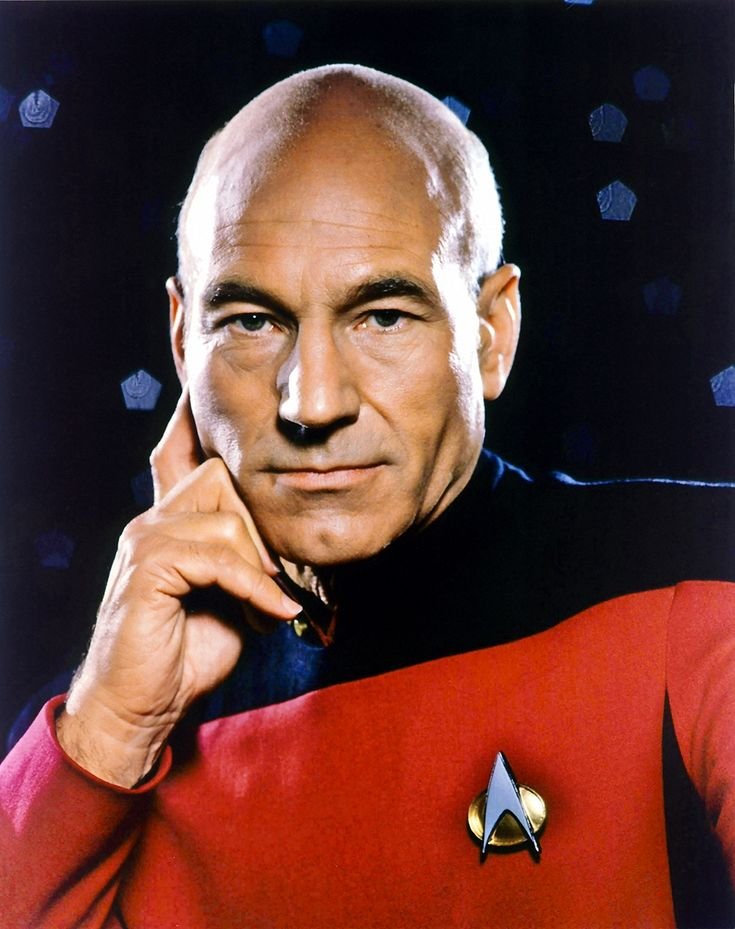
Better late than never, I wanted to weigh in on the recent passing of Sir Patrick Stewart.
Like a lot of folks, I first took note of Stewart in Star Trek: The Next Generation, although it turns out that when the show debuted in 1987, I’d already seen him in Excalibur, where I was more interested in the striking visuals of foggy forests, gleaming armor and weird magic, and in Lifeforce where I was more interested in the striking visuals of space vampire Mathilde May walking around stark naked for long stretches of the film.
I stuck with TNG because it had “Star Trek” in the title, but for the first two years or so it was a pretty lackluster affair that didn’t inspire much devotion. Having grown up on the Original Series, I wasn’t quite sure what to make of Captain Picard since he didn’t fit the “Kirk” mold at all. He was British (or “French”) for starters, plus bald, not particularly youthful and not the traditional “alpha male” TV hero. I wouldn’t have called him “charming,” either, in those early days. Indeed, he seemed deliberately engineered as a sort of Anti-Kirk, more cerebral than physical, more diplomat than warrior, governing more by consensus than decree. Where Kirk sat alone in a throne-like chair dead center on the bridge, emphasizing at once his primacy to the starship’s operation and to 90% of all plotlines, Picard sat in the middle of a trio of seats — actually lower than half the bridge stations — with his first officer on one side and his “counselor” on the other, suggesting command on the new Enterprise would be — like the plotlines — more of an ensemble affair.
For a while I just assumed first officer Will Riker was there to fill the “hero” role, being after all taller and American with a full head of hair and a Kirk-like swagger. A long-standing criticism of “old” Trek held that Kirk was a lousy captain for always personally involving himself in perilous activities it would have been wiser to delegate to others, so I assumed this was how the new show would fix things: letting an older, wiser captain make the big decisions from the center seat while the younger crowd handled the rough-and-tumble action, planetside. Hey, it had worked for the original Battlestar Galactica, so I was game. And yet Picard and Riker, for me, never quite combined to fill Kirk’s boots.
It wasn’t until the season 3 finale, part one of “The Best of Both Worlds” that I thought the showrunners had finally landed on a workable plan. In the episode, Picard is abducted by the machine race known as the Borg and assimilated into their collective, renamed “Locutus” and surgically transformed into a villain with the potential to be as scary and formidable as Darth Vader had been back when he was still cool (if you’re old enough to remember that). This creepy Locutus guy would have access to all of Picard’s training and experience, all his familiarity with the Enterprise’s systems and vulnerabilities, indeed lots of classified knowledge about Starfleet and Earth defenses, while abandoning human traits like mercy and restraint in favor of the Borg’s cold and merciless drive to conquer and control. Surely going forward, Picard/Locutus would be a villain for the ages and Riker could finally step into the limelight to realize all of his untapped potential, becoming a heroic starship captain in his own right. Both characters would finally be interesting! Yay!
Then after a long, tense summer for fans, Season 4 debuted with a speedy resolution to the whole mess. And naturally, I’d gotten it all wrong. Picard is rescued from the Borg and restored to his old human self. He resumes command and takes us right back to the status quo like nothing much happened at all. Oh well.
But no, I’d gotten it wrong again. In the very next episode (“Family”), the Enterprise returns to Earth, and Picard, shaken by the acts he’d committed as Locutus, considers leaving Starfleet to pursue another career. After an altercation with his estranged brother, the whole facade of infallibility he’s hidden behind for three seasons disintegrates as he breaks down sobbing at how the Borg had broken him: “I wasn’t strong enough. I wasn’t good enough!” And right there, not standing tall and proud on the bridge of the Federation flagship but lying in a puddle of mud and tears was a Picard I could finally care about. Not a stiff and stuffy moralizing scold or a by-the-book officer always above the fray, but a human being who could be, and was, broken and shattered and unsure how to go on. It was a “stealth” move by hero-making standards, finding a character’s strength in his admission of weakness rather than his ability to clobber a half-dozen guys (or a giant lizard) single-handed, or use his ship to defeat a whole squadron of opponents. For the first time, I felt for the guy, and from that point on he was the main reason I kept watching.
TNG was a good-looking show with impressive-for-the-time special effects, but it was also infamous for its reliance on “technobabble,” with the crisis-of-the-week often more rooted in starship maintenance than human relationships. This week the warp drive might be offline, next week the holodeck might malfunction and the week after that maybe we’d have a transporter accident, treating us to dire pronouncements about tachyon emissions, modulated shield frequencies, Level 1 diagnostics, holographic safety protocols and other assorted goobledy gook ad infinitum. More than anything, it was Stewart’s intensity and gravitas that made it work as well as it did, since he approached it all with the same respect as he would Shakespeare or Pinter. Thus we accepted that whatever all that jibberish meant, it must have been dreadfully important. I dimly recall an interview with Brent “Data” Spiner where he said Star Trek by nature is 50% Shakespeare and 50% running around the house with a towel tied around your neck, and Stewart made that balance work.
More than that, he leaned into the portrayal of Picard as a character who on the surface was implacable, imperturbable and all-knowing, but underneath harbored insecurity, regret and uncertainty. In a cast of more superficially arresting characters — a supergenius android, a first officer with superhero proportions, a blind navigator/engineer with a weird visor over his eyes, a shapely, empathic “counselor” in a skintight costume, a Klingon (!) security chief — the old, bald guy nonetheless became inarguably the most interesting character on the show. Where Mr Spock had emerged as the breakout character of classic Trek through his fascinating alienness, Picard defined TNG through his humanity.
Ask most fans for a list their favorite episodes and it’ll likely be dominated by the Picard-centric ones. There was “Darmok,” centering on Picard’s efforts to communicate with an alien captain in order to survive together on a hostile planet, “The Inner Light,” wherein he lives a lifetime as another man in the space of 20 minutes, and “Chain of Command,” where he’s broken down by physical and psychological torture. All are episodes that deal more with intellect, willpower and imagination than physical conflict or technological wizardry, and all in their own way leave Picard a changed person, a wiser, deeper and more complex character. Technically the show stuck to its guns and kept Picard from beaming down with the “away team” every week, but they also found plenty of ways to have him abducted, trapped by some shipboard disaster, crashed in a shuttlecraft, or caught in some misadventure on a vacation-gone-wrong, because there was just too much potential in the character not to keep at it. In “Sins of the Father,” Picard stands with Worf before the Klingon High Council and the antagonistic Duras, obviously resentful of the presence of an offworlder, tells him, “You must be ready to fight. Something Starfleet does not teach you.” Standing his ground, Picard replies coldly, “You may test that assumption at your convenience.” It’s a fancy way of saying FAFO, and a great moment for Picard. The fact that by this point we fully believe he can hold his own when challenged by a Klingon is a testament to how much our view of the character has shifted since first impressions.
The TNG theatrical films never really gelled like the earlier Treks, partly because they required Picard to shift gears to full-on “action hero” mode. Not that Stewart couldn’t handle action, and not that he wasn’t looking Die Hard-grade buff in Star Trek: First Contact, but physical derring-do doesn’t really play to Picard’s strengths as a character. It helped that in First Contact we see him still haunted by days among the Borg and driven by a long-simmering thirst for vengeance. For all the cool special effects and bam-bam, pew-pew in the film, Picard’s furious rant to Alfre Woodard’s character (“The line must be drawn HERE!”) and his about-face when she calls out the self-destructive nature of his mania is pretty much the high point of the film.
Stewart’s other huge pop culture role was that of Prof Charles Xavier in the X-Men films, where he slipped comfortably into the role of yet another confidence-inspiring father figure and again legitimized a lot of silly goings-on with his signature gravitas and stately bearing. Watching the aged Xavier slide into senility in Logan was equal parts heartbreaking and terrifying, and will be hard to watch again now given Stewart’s real-life struggle with dementia. After a strong death scene, it’s too bad they felt compelled to keep bringing Xavier back, but that’s superhero flicks for you. At this writing, Sir Patrick’s final film is still a month away in Avengers: Doomsday, where he’ll play Xavier one last time.
Equally as impressive as Stewart’s commitment to making even the most preposterous material seem deadly serious was his willingness to poke fun at his own image and be utterly silly in interviews and on social media, and the fact that he seemed to be everywhere all the time, right up to the end. You got the distinct impression he was determined to wring the most out of every second he’d been given. The universal outpouring of grief and affection from people all over the world at his passing suggests he spent that time doing all the right things, including working on behalf of causes to support battered women and victims of PTSD and helping legions of fans get through the Covid lockdown with his daily readings of Shakespearean sonnets via social media. For many, he was the same compassionate, calming father figure in real life he’d played on screen.
Anyway, those are my thoughts, for what they’re worth. Thanks, Sir Patrick, for all the hours of entertainment that will keep you alive for many generations. Rest In Peace.