LINKS
- Attack of the 50-Year-Old Comics
- Super-Team Family: The Lost Issues
- Mark Evanier's Blog
- Plaid Stallions
- Star Trek Fact Check
- The Suits of James Bond
- Wild About Harry (Houdini)
Today marks the 60th anniversary of Star Trek’s debut on network television, and while I said most of what I’d want to say about the show in my 50th anniversary post, I figure it’s worth acknowledging another milestone.
In the decade since that last post, the modern film franchise (“Abrams Trek?” “Kelvin Timeline?” “NuTrek?”) has petered out, two new spin-off TV series have come and gone (though a few episodes have yet to air) and the future of on-screen Trek is very much up in the air. Aside from briefly re-releasing the first four films to select cinemas, very little is being done to celebrate the occasion.
Things were a lot more interesting, and arguably hopeful, 50 years ago this month when NASA’s prototype space shuttle made its global debut on September 17, 1976, bearing the name “Enterprise” in honor of Starfleet’s fictional flagship.
Trust me, this was a much more remarkable occurence back before the rise of geek culture. Today it might not seem so surprising to see a real-world government project make a nod to popular fiction (heck, the recently formed U.S. Space Force flat out stole the Starfleet delta shield as its emblem) but in 1976 the concept of naming the first space shuttle after a make-believe TV starship was pretty darned radical. As someone who grew up in an age where admitting a love for science fiction and comic books could still get you knocked down and your eyeglasses taken away, it was a decided triumph for the nerdverse.
Originally slated to be called “Constitution,” the prototype orbiter (OV-101) was renamed thanks to a massive letter-writing campaign by Star Trek fans, although President Gerald Ford never actually cited the campaign as the reason for the change, nor formally acknowledged the connection to the Federation’s flagship. Nonetheless when the orbiter debuted to the world press at the Rockwell plant in Palmdale, California, Trek creator Gene Roddenberry and most of the original series cast were included in the ceremonies.
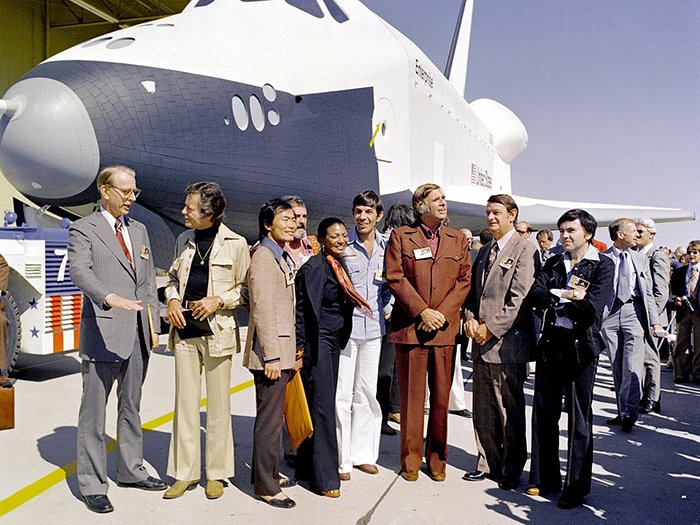
Looking at that image, I’m not sure what’s more amazing; that the US government bowed to the wishes of fandom, that seven years after its cancellation due to middling ratings Star Trek was on the cusp of rebirth as a money-making juggernaut that would spawn 13 movies and over 900 episodes of various spin-off series, or that grown adults once felt comfortable leaving the house in bell-bottoms and leisure suits.
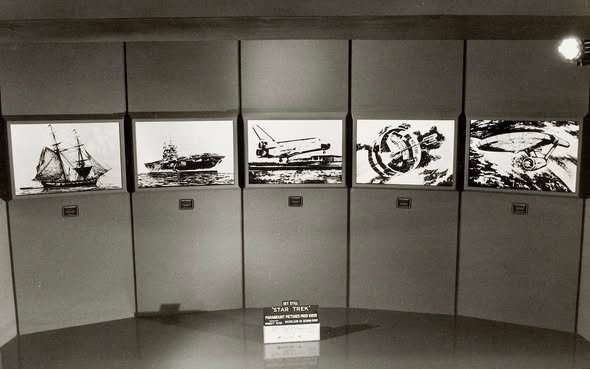
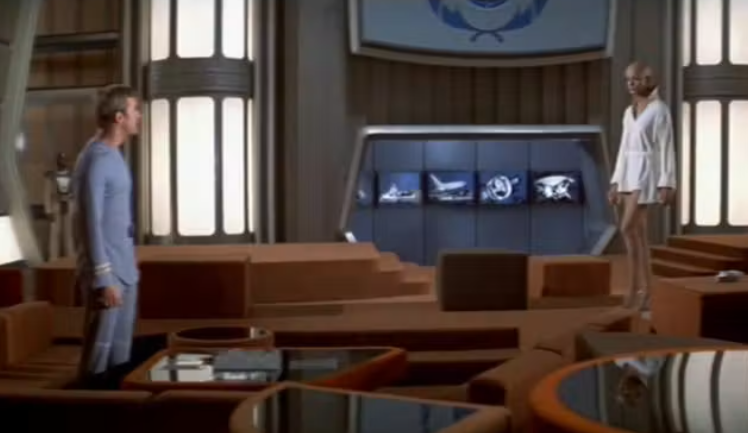
NASA’s Enterprise never got much closer to space than the models used on the Desilu soundstages, lacking as it did heat shields or engines, but now the connection was formally established between the real-life space program and its fictional counterpart, at once inspired by and inspiration for for generations of astronauts. In an early “meta” moment, 1979’s Star Trek: The Motion Picture would reinforce the link by including the orbiter in a pictorial “Hall of Fame” of historical vessels named Enterprise, as displayed on one wall of the starship’s recreation deck.
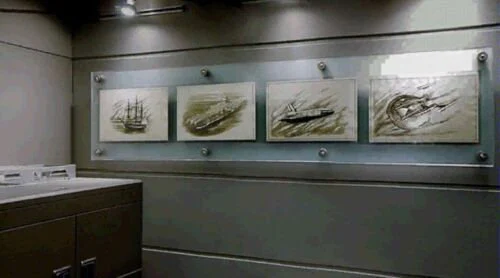
Still later, a drawing of the shuttle would feature in a similar display on the wall of Captain Jonathan Archer’s office in the “prequel” series Star Trek: Enterprise (third from left, below).
Naturally this sort of thing always delights that part of our brains that likes to blur the line between fantasy and reality. I mean, if there was a space shuttle Enterprise in the Star Trek universe’s past, and if that shuttle would never have been given the name except for the popularity of the Star Trek TV show, then the TV show must exist in the same reality as the Federation, yes? Therefore the future shown on the show is *our* future, right? Well, maybe not, but it was fun to think so.
After the Challenger tragedy, NASA’s Enterprise was considered for a refit that would’ve made it space-worthy, but the plans went nowhere. Later still it was used in tests to recreate the conditions that led to the shuttle Columbia disaster. It now resides at the Intrepid Museum in NYC.
Anyway, this little news item from 50 years ago is a neat reminder of where things stood for Trekkies in those uncertain, wilderness years between TOS and the first film, giving an early promise to us long-suffering nerds that soon enough the geeks would inherit the Earth. Of course there’s a certain irony to the fact that fans managed to get the named changed for the one orbiter that never managed to actually achieve orbit.
Where Trek will go from here — if anywhere — is anyone’s guess, but here in 2026, just as surely as 1966, there’s obvious appeal in any fictional reality that suggests we might actually crawl out of the hole we’ve dug for ourselves to reach the stars and a brighter future. Sure Star Trek is make-believe, but if we’re going to imagine a future for ourselves, it couldn’t hurt to make it a good one, right?