LINKS
- Attack of the 50-Year-Old Comics
- Super-Team Family: The Lost Issues
- Mark Evanier's Blog
- Plaid Stallions
- Star Trek Fact Check
- The Suits of James Bond
- Wild About Harry (Houdini)
Celebrating as it does the tricentennial issue of Superman in what was America’s bicentennial year, you might well have expected something splashier from issue #300: A page boost to 64 pages, a host of superhero guest stars, a “victory lap” retrospective of all the great moments in the super-mythos, maybe even the Neal Adams art job originally announced but abandoned for some reason. What we got instead was a standard-sized issue, cranked out by the resident creative team and not only lacking “special guest stars” but bereft of even series regulars like Lois Lane, Jimmy Olsen and Perry White.
And yet, at least in my opinion, it’s truly awesome despite all that, or maybe because of it.
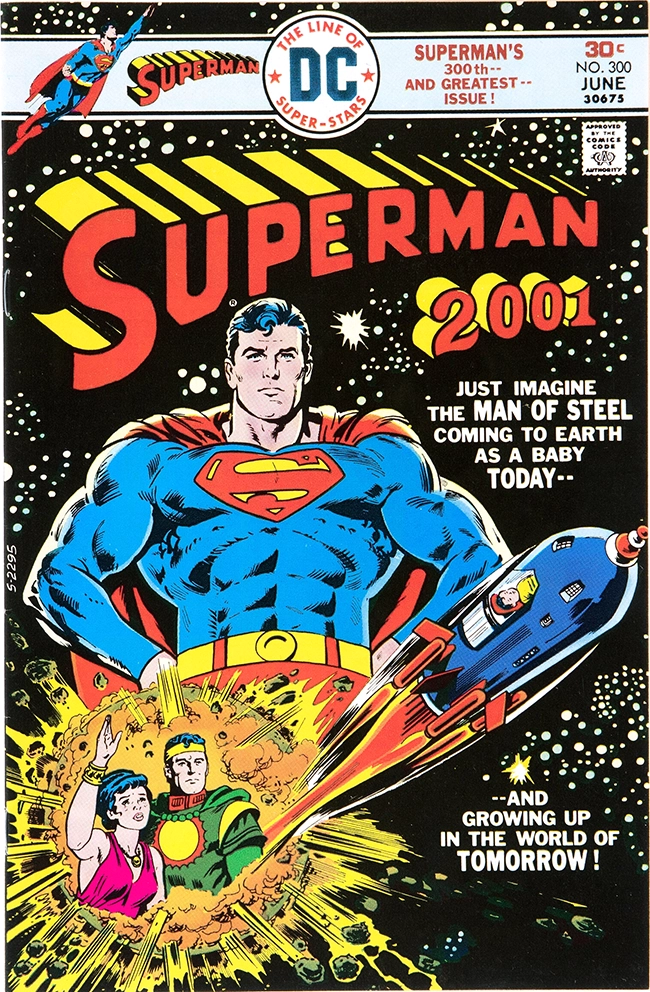
Our story begins in familiar territory, with the planet Krypton exploding moments after Jor-El and Laura rocket their infant son Kal-El to safety. But in a key twist, this time the spacecraft reaches Earth in the “present day,” specifically February 29, 1976 (conveniently perpetuating the tradition of Superman’s “birthday,” as 1976 is a Leap Year).
As the ship zips past the conjoined Apollo-Soyuz capsules orbiting Earth, the astronaut/cosmonaut crew radios the UFO’s progress to ground control, apparently much more concerned about that than the fact that they’re still locked together in orbit some seven months after their mission was supposed to have ended.
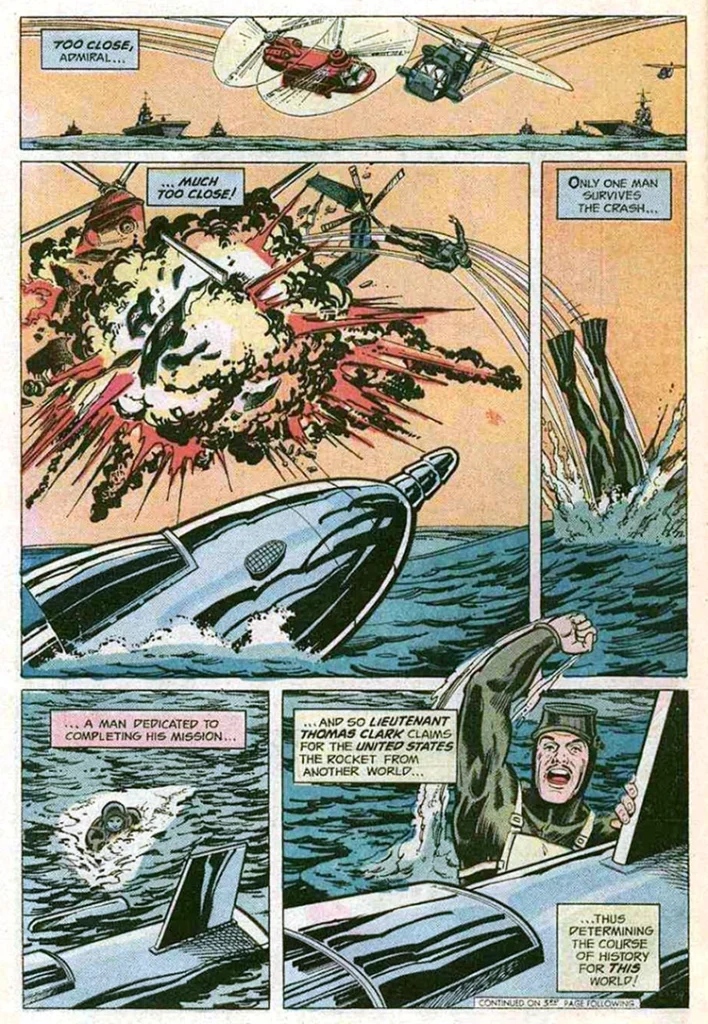
Rather than Smallville, this time the tiny ship splashes down in international waters, where U.S. and Soviet naval fleets await, each hoping to claim the UFO as their own. Alas, in their eagerness the respective retrieval teams collide their helicopters in a tragic accident, leaving only one survivor, an American who claims the spacecraft and its contents for the USA. His name: Lt. Thomas Clark.
Later, at a top-secret research facility, scientists are having no luck penetrating the UFO’s hull even with a “super-laser” (eat your heart out, Dr Evil) when suddenly out pops a child who is equally impervious to the laser’s effects…which is a good thing as the operator seems to lack the reflexes necessary to quickly turn it off when it’s pointed at a baby.
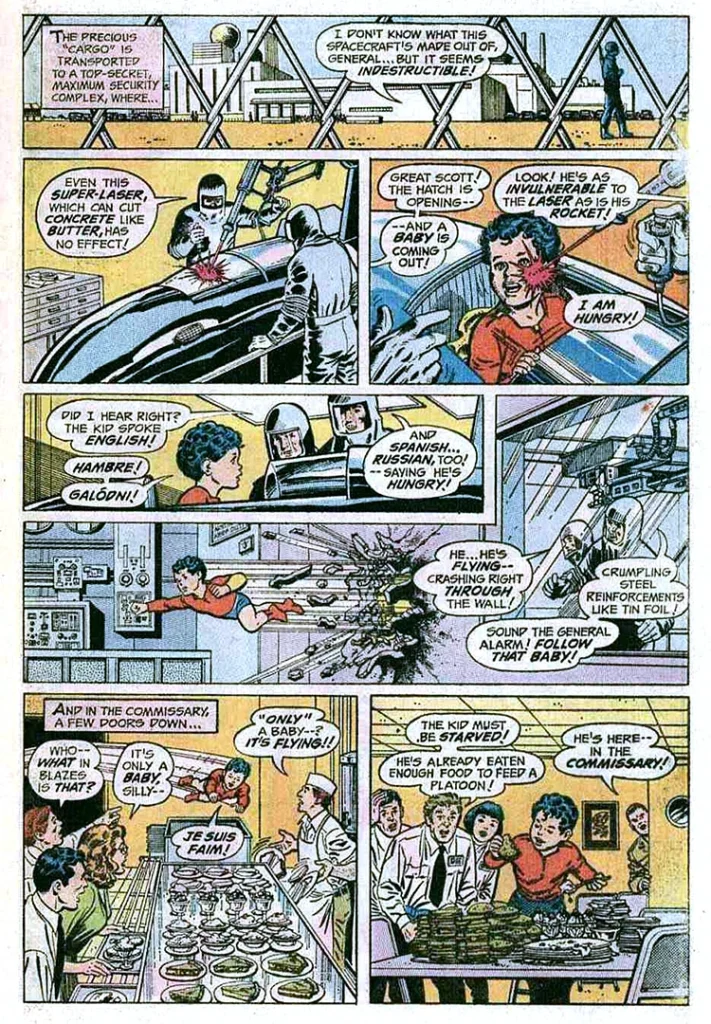
Everyone seems terribly impressed that the rugrat can speak multiple languages, but let’s face it, even mastering English is a major achievement given that all previous versions of Superbaby could only talk like Tonto or movie Tarzan (“Me want cookies! Me like doggie!”). Agog at the polyglottal toddler, U.S. Army General Kent Garrett is moved to ask a lieutenant, “Are you sure he is a baby?” to which the lieutenant replies, “Oh, yes sir! He told us so!”
At General Garrett’s instruction, the baby’s extraterrestrial blankets are made into a “uniform” (which of course is the wrong word for it as he’s got the only one, so I’ll call it a playsuit).
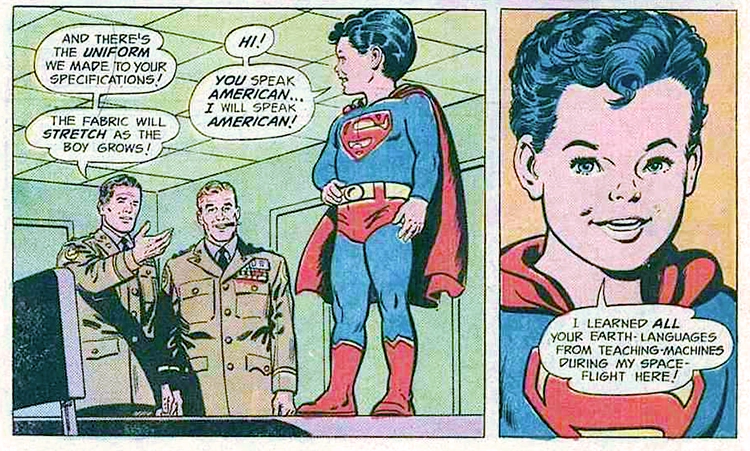
This may well be the first mention of Kal -El receiving a prerecorded education on his flight to Earth, an idea later explored in Superman: The Movie. Anyway, it’s the first instance I can recall.
The playsuit is emblazoned with the letter “S,” reflecting the code-name General Garrett has assigned the child: “Skyboy” (doubtless a nod to the youngster who served for a brief time as Superman’s Robin-like partner in 1958’s World’s Finest #98: “The Boy From Outer Space”).
Top-secret facility or not, leakers are gonna leak, and rumors soon reach the United Nations that the UFO may have had an alien baby on board. “If so,” argues a furious Soviet ambassador, “he belongs to all nations, not just one!”
Time marches on, and by 1990, the world has seen some remarkable changes. Here’s a refresher, in case you’ve forgotten what it was like in the 90s:
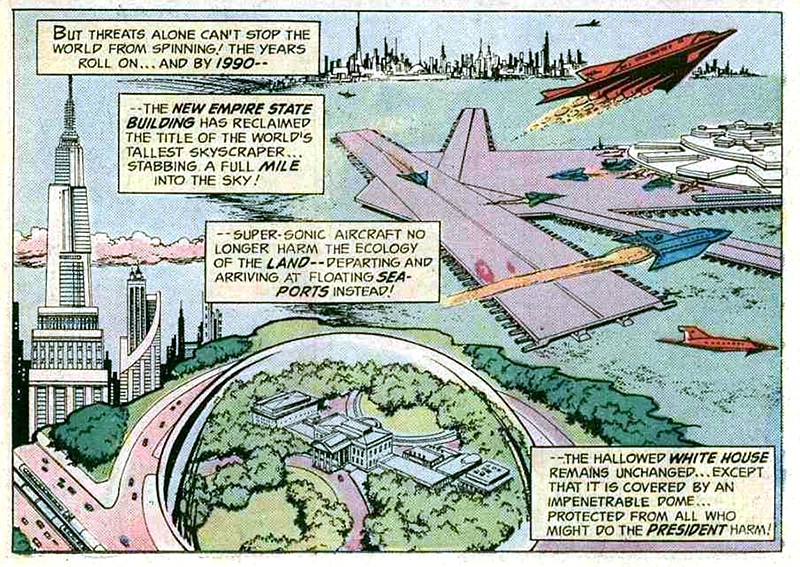
Three years before this issue arrived, Chicago’s Sears Tower had claimed the title of “world’s tallest skyscraper,” so the “New Empire State Building” is likely a display of Big Apple boosterism from the NYC-based writers. With Manhattan real estate always at a premium, we can only wonder if the city tore down the original ESB and built its successor on the same site just to reclaim bragging rights. The writers also foresee supersonic passenger aircraft like the Concorde becoming the norm by the 1990s, which obviously didn’t pan out, either. In an effort to protect “the ecology of the land,” the SST’s are shown arriving and departing from “floating sea-ports.” Aside from this giving the middle finger to marine ecology (take that, Aquaman!) we’re left to imagine the inconvenience to travelers needing to get back and forth to their land-based homes and businesses between flights. I guess the ferry business did pretty well in the 90s, too. As for a giant bubble over the White House, I’m all for it provided there are no holes to let air in.
Anyway, eager to finally thaw tensions with the global community, the American President decides to come clean about what was inside that UFO back in ‘76.
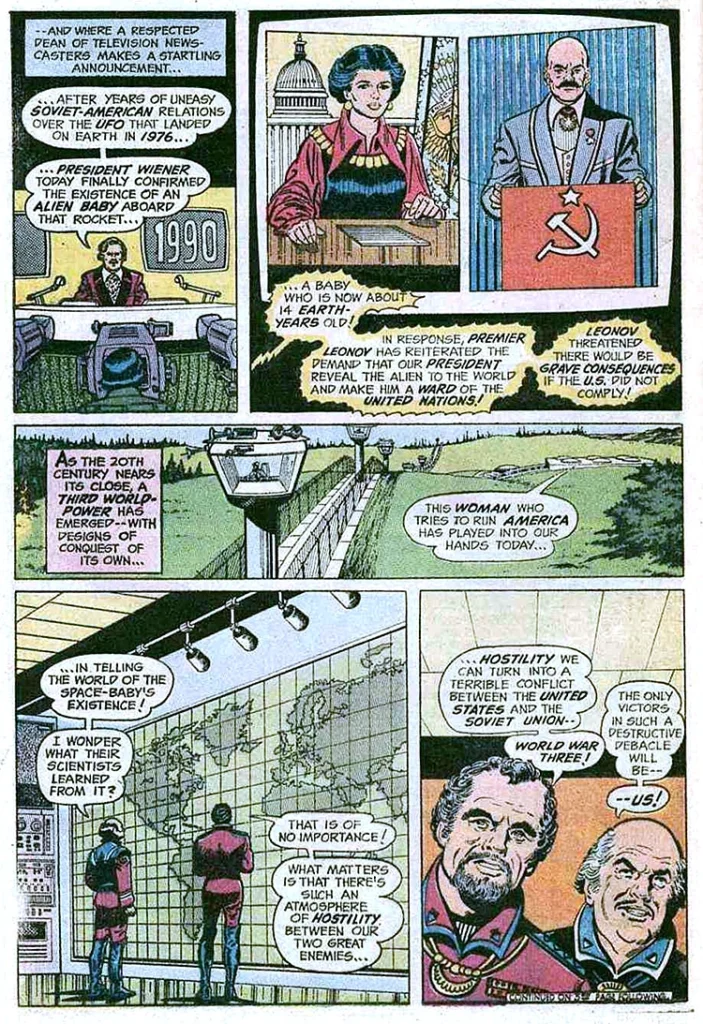
Here the writers guess wrong again by assuming we’d surely have a woman President by 1990. Even so, I give them partial credit for naming the POTUS “Wiener.” I think we can all agree there’s been more than a couple of those in office since the mid-70s.
We learn that a third world power has emerged by the 90s, “with designs of conquest of its own.” It’s never made clear where this nation is, but it’s shown with a wall and guard towers like East Berlin, so we can assume it’s not a democracy. Its leaders are pleased that President Wiener’s “alien child” revelation has heightened, not lessened global tensions, pushing the United States and the USSR ever closer to nuclear conflict. “The only victors in such a destructive debacle,” they gloat, “will be us!” This of course is right out of the Bond Villain Handbook, but as usual it makes no sense, as there wouldn’t be much of a world left to rule after a full-scale atomic war. Anyway, they manage to hack into both nations’ early warning systems, fooling each into thinking the other has launched a nuclear first strike, which results in real ICBMs being launched in “response.”
Dismayed at being the indirect cause of a possible nuclear Armageddon, Skyboy takes immediate action, intercepting all the missiles launched from both sides and hurling them into space. As drawn, it’s hard to believe this scene didn’t influence Superman IV: The Quest For Peace (not that anyone would want to take “credit” for inspiring that film).
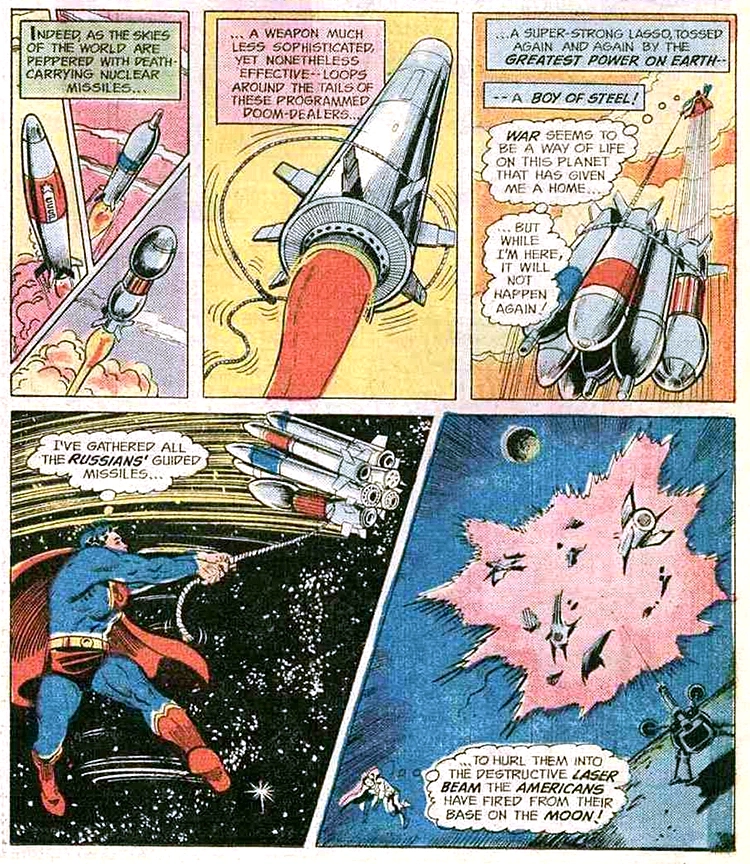
Skyboy tosses the weapons into the path of a U.S. laser weapon installed on the Moon (in clear violation of the 1967 treaty foreswearing the militarization of space!). Equally as indifferent to treaties and fair play as their American counterparts, the Soviets unleash a cloud of poison gas over California, but Skyboy diverts that into space as well.
Having narrowly escaped an extinction-level event, the people of Earth realize their salvation was likely the work of that mysterious alien super-youth they’ve heard so much about. But where is he? Did he die in the effort? Has he abandoned the warmongering Earth? It’s a mystery, but the chastened American President and Soviet Premier agree to disarmament talks, so all’s well that ends well.
Alas, the excitement was too much for father figure General Kent Garrett, who’s suffered a fatal heart attack. A grieving Skyboy decides to take this as his cue to disappear from the world stage and live his life as an ordinary mortal, taking the name “Clark Kent” in honor of both the late general and the Navy diver who claimed his ship. Vowing never to use his powers again, he packs his super-suit in a valise and tosses it into the ocean.
We leap forward again to December 31, 2000, where the giant clock in Times Square is counting down the minutes to 2001 and the arrival of a new century/millennium.
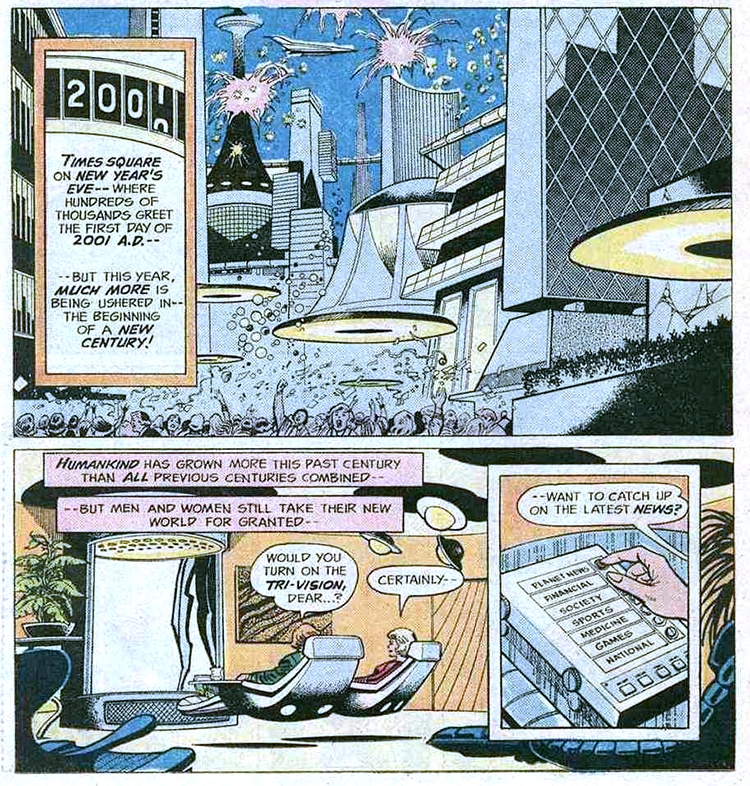
Here the creative team’s prognostications miss the mark again, not because of the giant, levitating, disc-shaped lights shown illuminating Times Square, but because we know that in the real world, everyone would forget how numbers work and decide to celebrate the arrival of the “new millennium” on New Years Eve, 1999.
Thanks to “a huge communications linkup,” people around the world are able to watch the celebrations via “a 24-hour news network,” and who should be the anchorman but our old friend Clark Kent, having done quite well for a guy who can’t have any school records or even proof of citizenship after growing up in basically Area 51. Perhaps without a secret identity to protect, he was able to achieve his full potential like the powerless Clark Kent did back in issue #297, rising to the top of his profession on sheer boldness and personal charm.
In the news: a four-armed figure is standing atop the countdown clock in Times Square and claiming to be the mysterious alien who saved Earth from destruction years earlier. He calls himself Moka, but plainly not because he’s full of chocolatey goodness.
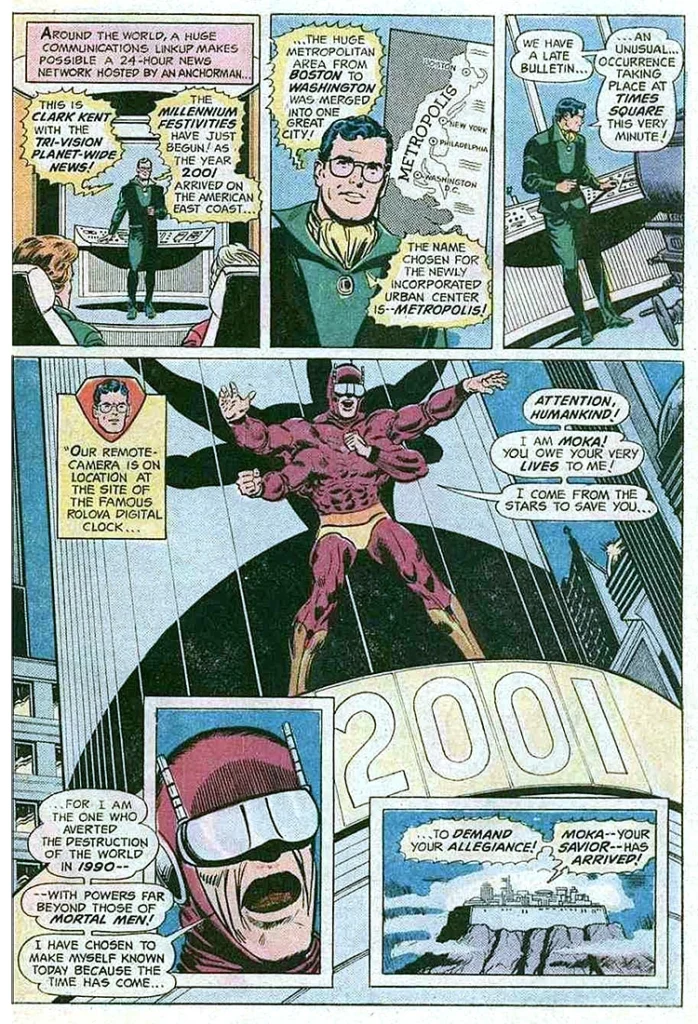
It turns out this is actually Round 2 in that unnamed world power’s efforts to conquer the globe. “Moka” is in fact an android of their creation, and if the worshipful people of Earth can be convinced to follow his orders, his creators will be running the world. (Presumably they’ve created Moka with four arms because nobody’s quite sure what an “alien savior” looks like).
Clark Kent is the only other man alive who knows Moka is not what he claims, so he retrieves his old super-costume from where he dumped it and flies to Times Square to confront the imposter. Moka gets in the first couple of licks, to the cheers of the crowd, but Clark/Skyman ultimately pulverizes the android on worldwide TV.
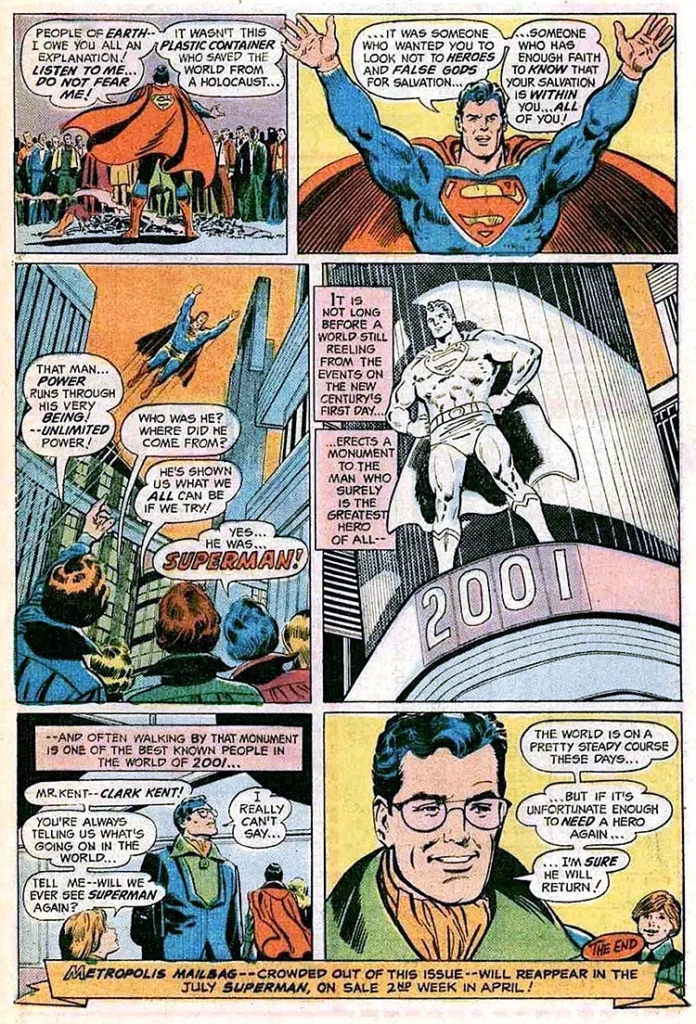
In an impassioned speech, Clark/Skyman tells the people of Earth to “look not to heroes and false gods for salvation” but instead seek salvation within themselves. Proving the dependability of mankind to forever miss the point, they immediately erect a statue in his honor, and it’s only here, on the last page, that he finally gets the name “Superman.” In the last panel, Clark leaves open the possibility that Superman may one day return.
What can I say, I loved this issue. Cary Bates and Elliott Maggin were my favorite writers of Bronze Age Superman, Curt Swan was absolutely still bringing his A-game and Bob Oksner was a stellar partner for him on inks. Any issue where these guys were firing on all cylinders was “special” enough for me.
The authors nicely explore the potential social and political impact a superbeing might have on the real world without indulging in the jadedness or nihilistic excess of say, “The Boys” (or even Zack Snyder’s Superman). This is the kind of story that makes the Bronze Age my sweet spot: it’s a little “grown up” but not too much.
Superman, despite being raised by an Army general and his staff instead of a kindly small-town couple, emerges with his character-defining ethos intact. But then, this issue did arrive in our Bicentennial year, so the message may have been that landing anywhere in the U.S., and being raised by any American would be enough to make Kal-El grow up right.
Naturally this sort of tale is also fun to return to in hindsight, when we know how accurate the predictions were, or weren’t. It’s fun to see the fashions Swan gives Clark and others in the year 2000, with the funny collars and opera capes. It’s cool that in their way the authors predicted things like CNN and the internet and “couch potato” culture. And it’s sobering to recall that in 1976 neither they nor any of us could have imagined the 21st century without a still-intact, still-adversarial Soviet Union.
Sometime in 1976, young me mailed away for a “Comics Keeper,” advertised as an exciting and efficient way to store and shelve comics. It turned out to be a sort of plastic report cover: imagine a 3-ring binder but with flimsier covers and instead of ring clamps, a metal strip down the inner spine with notches to attach rubber bands. The idea was that you ran the rubber bands through the center of your comics (with room for 10 of them, maybe; I can’t remember) and presto, instant “bound edition.” Of course it was a terrible idea for all kinds of reasons, not least because rubber bands don’t last very long, but Superman #300 took place of honor as the first book to go into the “keeper.”
It didn’t take long to decide I didn’t like that thing, so the “test run” never led to further purchases and I soon freed the issue from its rubber band bondage. Still in good condition, it survived my youthful folly. Which is good, because I still consider it a keeper.